
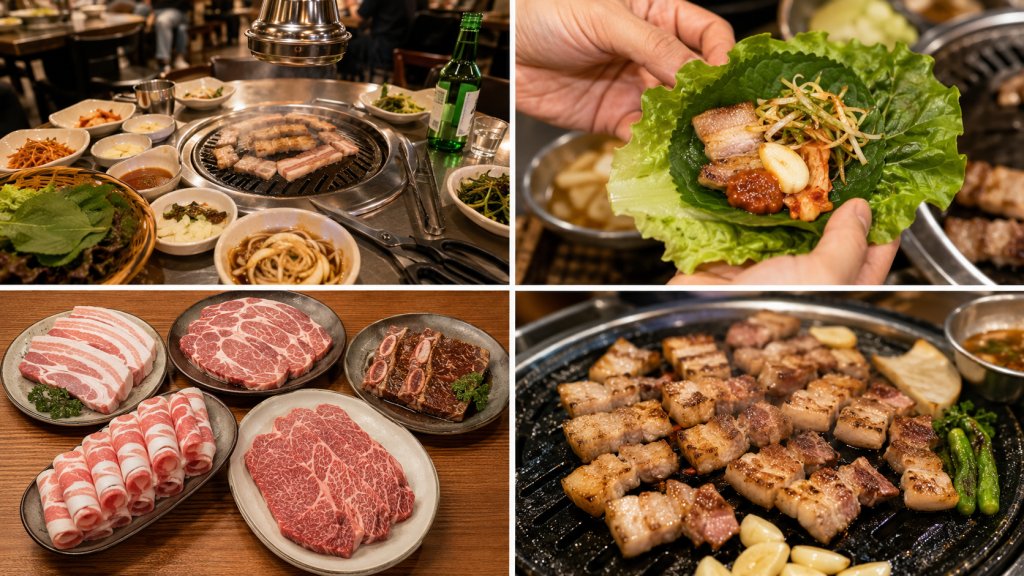
Korean BBQ for Foreigners: How to Order Without Stress
Planning your first Korean BBQ meal in Korea? This guide walks you through exactly what to order, how the grill works, what things cost, and how to avoid the small table mistakes that make first-timers nervous.
After years of eating Korean BBQ in Seoul with visiting friends, I’ve found that the anxiety usually disappears after the first five minutes. The server lights the grill, scissors are normal, side dishes are meant to be refilled, and samgyeopsal is almost always the safest first order.
This post contains affiliate links. If you book through them, I may earn a small commission at no extra cost to you. I only recommend services I’ve personally used or vetted.
Quick Answer
- What to order first: Samgyeopsal (pork belly). Don’t overthink it — this is the classic first Korean BBQ order.
- You will not look stupid: The server lights the grill, may cook the first round, and scissors are the correct cutting tool.
- Budget reality: A solid mid-range BBQ meal for two usually runs around ₩55,000–₩75,000, about USD 40–55, depending on drinks and meat quality.
- Skip premium Hanwoo on your first visit: It can cost ₩50,000–₩90,000 per portion. Start with pork first, then try Hanwoo later.
Everyone who visits Korea hears the same sentence: “You have to try Korean BBQ.” Then nobody explains what happens after you sit down.
You walk into a restaurant, the table has a grill in the middle, the menu is half Korean cuts of meat, and you’re not sure whether you should cook the pork yourself or wait for the server. This guide is the version I wish every first-time visitor had open on their phone before dinner.
1. The Two Grill Types — And Which to Pick
Most Korean BBQ restaurants use either a charcoal grill or a gas grill. Both are normal, and both can give you a good meal.
Charcoal grills, usually shown as sutbul or 숯불 on signs, give the meat a deeper smoky flavor. The fat from pork belly renders over live coals, which makes the edges crispier and the smell stronger. The downside is simple: your jacket may smell like smoke for the rest of the night.
Gas grills are more common at chains and casual BBQ restaurants. They heat quickly, are easier for servers to manage, and are very beginner-friendly. For your first Korean BBQ meal, gas is completely fine.
Practical tip: If you specifically want charcoal, search for “숯불구이” on Naver Map or Kakao Map. If you just want a reliable first meal, choose a busy restaurant around 6:30 PM with a steady line and fast table turnover.
2. The Cuts: What to Order First
Korean BBQ menus can feel complicated, but most first-timers only need to understand a few cuts.
| Cut | Korean | What it is | Best for |
|---|---|---|---|
| Samgyeopsal | 삼겹살 | Pork belly | First-timers |
| Moksal | 목살 | Pork shoulder | People who want leaner pork |
| Galbi | 갈비 | Short rib, often marinated | Sweet, richer flavor |
| Chadolbaegi | 차돌박이 | Thin-sliced beef brisket | Quick cooking |
| Daepae samgyeopsal | 대패삼겹살 | Thin-sliced pork belly | Cheap, fast meals |
| Hanwoo sirloin | 한우 등심 | Premium Korean beef | Splurge meal |
First-timer recommendation: Order samgyeopsal first. It is fatty, forgiving on the grill, easy to wrap, and exactly what most visitors imagine when they think of Korean BBQ.
If you want one extra cut, add chadolbaegi. It cooks in about 30 seconds, so you can eat something while the pork belly is still rendering.
Honest take: Skip premium Hanwoo on your first Korean BBQ meal. Hanwoo is excellent, but if everything about the meal is new — the grill, the wraps, the sauces, the side dishes — the difference between good pork and expensive beef will not land properly yet.
3. The Order of Operations: What Happens at the Table
Here is the actual flow of a Korean BBQ meal.
Step 1: Sit down and check the table
You’ll usually see dipping sauces, metal chopsticks, scissors, tongs, and a grill built into the table. The scissors are for cutting meat. This is normal, not a shortcut.
Step 2: Side dishes arrive
Banchan means small side dishes served with the meal. At a BBQ table, this usually includes kimchi, pickled radish, raw onion in soy sauce, lettuce, perilla leaves, garlic, green chili, and scallion salad.
Most banchan can be refilled for free. You can say “more kimchi, please” or simply point and ask politely.
Step 3: Order meat by portion
Korean BBQ meat is usually ordered by inbun, meaning one portion. One portion is often around 150–200g of raw meat, depending on the restaurant.
For two adults, start with two or three portions. Do not order everything at once. Korean BBQ is better when you add more meat slowly.
Step 4: The server lights the grill
At many restaurants, the server will cook the first round for you. Watch how they flip, cut, and move the meat to the side of the grill.
Once they leave, you take over. Pork belly should be browned and cooked through. Thin beef like chadolbaegi only needs a short time on each side.
Useful Pre-Trip Resource
If you rely on translation apps or Naver Map while eating out in Korea, set up mobile data before landing. A Korea eSIM is usually easier than renting pocket WiFi.
4. The Wrap Method — How to Eat Ssam Properly
Ssam means a wrap. This is one of the main reasons Korean BBQ feels different from just eating grilled meat.
- Take a lettuce leaf or perilla leaf.
- Add a small amount of ssamjang, a thick soybean and chili dipping paste.
- Place one piece of cooked meat on top.
- Add garlic, scallion salad, kimchi, or chili if you want.
- Fold it into one small bundle and eat it in one bite.
The one-bite part matters. A good ssam should be small enough to eat at once. If your wrap is too big and falls apart, just make the next one smaller.
No one is going to shame you for getting it wrong, but smaller wraps taste better anyway. You get the leaf, meat, sauce, garlic, and kimchi in one clean bite.
5. Drinks: Soju, Beer, and Makgeolli
Soju is Korea’s most common distilled liquor. At BBQ restaurants, one bottle usually costs around ₩5,000–₩7,000, about USD 4–5.
Beer is equally common, and many people mix beer and soju into somaek, a soju-beer combination. You have probably seen this in Korean dramas.
For a first visit, don’t feel pressured to perform the soju bomb ritual. There are small etiquette rules around pouring and receiving drinks, especially with older people. If you are traveling without Korean friends, just order beer or soju and keep it simple.
Makgeolli is an unfiltered Korean rice wine with a milky texture and light fizz. It has lower alcohol than soju and pairs well with pork, especially if your table wants something softer.
6. The End-of-Meal Closer
Korean BBQ usually ends with something hot, cold, or starchy. This helps settle the richness of grilled meat and gives the meal a proper finish.
- Doenjang jjigae: Fermented soybean paste stew with tofu, zucchini, mushrooms, and sometimes clams.
- Naengmyeon: Cold buckwheat noodles served in chilled broth or spicy sauce.
- Fried rice: Some restaurants fry rice directly on the grill after the meat.
If the server asks whether you want stew, noodles, or rice at the end, say yes unless you are completely full. For first-timers, doenjang jjigae is the safest closer.
7. Solo and Small-Group Options
Traditional Korean BBQ restaurants often have a two-person minimum order. This is not meant to be rude. It is simply how the grill, table space, and meat portions are structured.
If you are traveling alone, search for “1인 BBQ” or “혼밥 BBQ” on Naver Map. Hongdae and Gangnam usually have more solo-friendly restaurants because they get more students, office workers, and travelers.
For groups of three or more, Korean BBQ is easy. Just avoid peak Friday and Saturday dinner time if you hate waiting. Popular places can run 30–45 minute waits around 7 PM.
8. Korean BBQ Cost Expectations in 2026
Prices vary by neighborhood and meat quality, but these are realistic first-timer expectations as of May 2026. Prices and hours can change, so verify on the restaurant or booking page before visiting.
| Item | Typical price | Approx. USD |
|---|---|---|
| Mid-range samgyeopsal | ₩15,000–₩22,000 per portion | USD 11–16 |
| Premium Hanwoo | ₩50,000–₩90,000 per portion | USD 37–66 |
| Lunch set | ₩12,000–₩18,000 per person | USD 9–13 |
| Soju | ₩5,000–₩7,000 per bottle | USD 4–5 |
| Beer | ₩4,000–₩6,000 per bottle | USD 3–4.50 |
A realistic two-person dinner with two or three pork portions, one stew, rice, and drinks usually lands around ₩55,000–₩75,000 total, about USD 40–55.
All-you-can-eat warning: Skip unlimited BBQ for your first proper meal unless you are on a very tight budget. The meat is usually thinner, the sourcing is less careful, and the table experience can feel rushed.
Food Tour Option
If ordering in Korean still feels stressful, a guided Seoul food tour can be worth it on your first or second night. It gives you a safer intro to markets, drinking etiquette, side dishes, and dishes you may not order alone.
9. Hanwoo: When It Is Worth It
Hanwoo is Korean native beef, known for rich marbling and a softer texture. It is one of Korea’s serious food splurges.
It is worth it if you have already tried pork BBQ, you are traveling with someone who wants a special dinner, and you are comfortable spending ₩100,000–₩150,000 for two people just on meat.
The best approach is to treat Hanwoo as its own meal, not as an add-on after pork belly. Look for a restaurant that specializes in Hanwoo sirloin or galbi, order less, eat slowly, and focus on the beef.
For a first Korean BBQ night, though, I would still start with samgyeopsal. It gives you the full Korean BBQ rhythm — grill, cut, wrap, drink, stew — without making you worry about whether you are overcooking expensive beef.
Final Thoughts
Korean BBQ looks intimidating from the doorway, but it is one of the easiest meals to enjoy once you sit down. Order samgyeopsal, let the server start the grill, use the scissors, keep your wraps small, and finish with stew or noodles.
The point is not to perform Korean dining perfectly. The point is to relax into the table, eat at the same pace as the people you came with, and leave smelling slightly smoky in the best possible way.
Plan Your Trip — Quick Resources
- Search for a South Korea eSIM on Airalo — use the eSIM Store and search “South Korea” before your trip.
- Browse Seoul food tours on Klook — compare Korean BBQ, market food, night dining, and local food tours.
- Browse Seoul cooking classes on Klook — a good option if you want to understand Korean sauces, side dishes, and home-style food.
Official References
Read Next
The related articles below should be published first, then linked after the final WordPress URLs are confirmed.
- Korean Food Guide for First-Time Visitors
- Gwangjang Market Food Guide
- 3 Days in Seoul: First-Timer Itinerary
- Korea Travel Guide for First-Time Visitors
Prices and hours are subject to change. Verify on the official restaurant, booking platform, or tourism site before visiting. Price estimates verified May 2026.
 KOREA TRIP
댓글 남기기