Korean Food Guide for Foreign Visitors
What to Eat in Seoul: Korean Food Guide for Foreigners
If you only have a few days in Seoul, do not waste every meal in Myeongdong. This guide shows what to order first, how much to expect, where each dish makes sense, and the small food-etiquette details that make your first Korean meal easier.
After 8 years living in Seoul and hosting first-time visitors, I’ve learned that the best Korean food experiences are rarely complicated. Walk three blocks away from the main tourist street, sit where office workers are eating lunch, and order the dish that restaurant is built around.
Quick Answer: What Should You Eat First in Seoul?
If this is your first Seoul trip, start with samgyeopsal (grilled pork belly), kimchi jjigae (kimchi stew), naengmyeon (cold buckwheat noodles), tteokbokki (spicy stir-fried rice cakes), and dakgalbi (spicy stir-fried chicken). These five give you the best mix of table-grill culture, everyday comfort food, summer noodles, street snacks, and shared meals.
Typical casual meals run about ₩8,000–₩18,000 per person, roughly US$6–13 depending on exchange rate. Korean BBQ usually costs more because meat is ordered by portion; expect about ₩16,000–₩25,000 per person at an ordinary pork BBQ restaurant. Prices are verified as practical Seoul ranges for May 2026, but always check the menu before ordering.
Pre-Book Before You Go
- Get your Korea eSIM on Airalo — useful for Naver Map, Papago, and restaurant searches the moment you land.
- Book a Seoul food tour on Klook — good if you want to handle Gwangjang Market without guessing at stalls.
- Reserve a Korean cooking class on KKday — best for food-focused travelers who want more than restaurant hopping.
The Korean Foods I Would Prioritize
1. Samgyeopsal: grilled pork belly
Samgyeopsal is the Korean BBQ order I recommend first because it is simple, social, and hard to ruin. The pork is usually not marinated. You grill it at the table, dip it in salt-sesame oil or ssamjang (fermented soybean and chili paste), then wrap it in lettuce or perilla leaf with garlic.
Mapo, Hongdae, and Mangwon are better first picks than the most photographed BBQ streets in Myeongdong. The resident move is to choose a place with a short Korean menu, a little smoke in the room, and tables turning quickly.
2. Kimchi jjigae: the lunch stew that actually matters
Kimchi jjigae is a bubbling stew made with aged kimchi, tofu, pork or tuna, and red pepper broth. It is not photogenic in the polished travel-magazine way. It is exactly what you want on a cold day or after too much walking.
At a normal lunch restaurant, it usually comes with rice and banchan (small side dishes). Look for office workers eating quickly around noon; that is often a better signal than English signage.
3. Bibimbap: order the stone bowl version
Bibimbap is mixed rice with vegetables, egg, meat, and gochujang (Korean red chili paste). For your first time, order dolsot bibimbap (hot stone bowl bibimbap) if it is available. The rice crisps at the bottom, which makes the dish much better than the airport-food version most visitors know.
Insadong and Jongno are easy areas to try it during a palace or museum day. Mix thoroughly, but add the sauce in stages if you are not sure about spice.
4. Naengmyeon: cold noodles for humid Seoul weather
Naengmyeon is cold buckwheat noodles served either in icy broth or mixed with spicy sauce. In July and August, when Seoul feels heavy and humid, this dish makes complete sense after the first bite.
For your first bowl, order mul naengmyeon (broth-based cold noodles) and taste the broth before adding mustard or vinegar. Pyongyang-style naengmyeon restaurants around Eulji-ro can feel plain at first, but that quiet beef-broth flavor is the point.
5. Dakgalbi: the group dinner tourists skip too often
Dakgalbi is spicy marinated chicken stir-fried on a wide pan with cabbage, rice cakes, sweet potato, and sauce. It is cooked at your table, usually by staff, and works best with two or more people.
The finishing move is fried rice after most of the chicken is gone. Do not skip it unless you are already painfully full.
6. Sundubu jjigae: soft tofu stew that arrives still bubbling
Sundubu jjigae is spicy soft tofu stew, often with seafood, pork, or mushrooms. It comes to the table boiling hot, and many restaurants give you a raw egg to crack into the broth.
This is one of the easiest solo meals in Seoul. Sit down, order one stew, eat it with rice, and you are done in 25 minutes.
7. Samgyetang: ginseng chicken soup for summer
Samgyetang is a small whole chicken stuffed with rice, ginseng, garlic, and jujube, served in a clear broth. It is traditionally popular on the hottest days of summer, which surprises many visitors because the soup is hot.
It is mild, not spicy, and useful if you need a break from red pepper. Expect tourist-famous restaurants to have lines; go before noon if the restaurant is well known.
Seoul Food Price Guide
These are practical casual-dining ranges, not luxury restaurant prices. Seoul prices move by district, ingredient quality, and whether you are sitting in a tourist-heavy area. Verified May 2026; prices and hours subject to change.
| Food | Typical Seoul price | Approx. USD | Best situation |
|---|---|---|---|
| Samgyeopsal | ₩16,000–₩25,000 per person | US$12–19 | Dinner with 2+ people |
| Kimchi jjigae | ₩8,000–₩11,000 | US$6–8 | Fast local lunch |
| Bibimbap | ₩9,000–₩15,000 | US$7–11 | Easy first Korean meal |
| Naengmyeon | ₩11,000–₩16,000 | US$8–12 | Hot summer afternoon |
| Dakgalbi | ₩13,000–₩18,000 per person | US$10–13 | Shared group dinner |
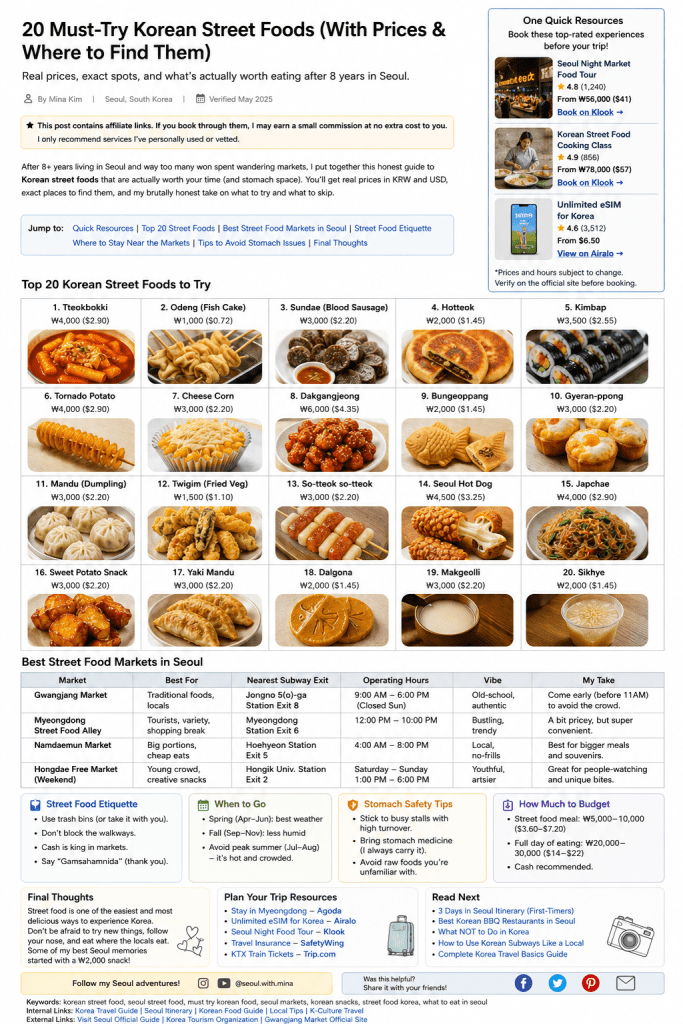
| Tteokbokki | ₩4,000–₩8,000 snack / more for table-style | US$3–6 | Street food or casual snack |
Street Food and Markets: Tteokbokki, Kimbap, Hotteok
Tteokbokki is chewy rice cakes in a red chili sauce, usually with fish cake and sometimes boiled egg. Sindang is the classic area for table-style tteokbokki, while markets and snack shops sell faster street versions.
Kimbap (seaweed rice rolls) is the most underrated budget meal in Seoul. Convenience-store kimbap is fine in a pinch, but made-to-order rolls from a small shop are much better and often come with soup.
Hotteok (sweet filled pancake) is best in winter. The outside is crisp, the inside is hot brown sugar and cinnamon, and you should wait a minute before biting unless you want to burn your mouth.
For a first market meal, Gwangjang Market is still useful, especially for bindaetteok (mung bean pancake), mayak kimbap (small rice rolls), and yukhoe (Korean seasoned raw beef). Go before peak dinner time if you want to eat instead of just shuffle through crowds.
Korean Food Etiquette: Banchan, Spice, and Tipping
Banchan are the small shared side dishes placed on the table before or with your meal. They are usually included in the price and refillable. To ask for more, say “deo juseyo”, which means “more please,” while pointing to the dish.
Do not tip in restaurants. It is not expected, and in ordinary restaurants it can create confusion. Pay at the counter when you leave unless staff bring a bill folder to your table.
For spice, memorize “mapji anke haejuseyo”, meaning “please make it not spicy.” This helps, but Korean “not spicy” can still mean red pepper is present. If you truly cannot handle heat, start with bulgogi, kimbap, japchae, jjajangmyeon, or samgyetang.
Vegetarian and Dietary Restrictions in Seoul
Vegetarian eating in mainstream Korean restaurants is harder than many guides admit. Fish sauce, anchovy broth, seafood stock, and meat-based seasoning appear in dishes that may look vegetable-only.
The most reliable route is sachal eumsik (Buddhist temple cuisine), which is traditionally plant-based and avoids meat and fish. Insadong is a practical area to start because temple-food restaurants, palaces, and galleries are close together.
For gluten-free travelers, be careful with soy sauce because wheat is common. Bring a written dietary card in Korean, and choose restaurants deliberately rather than assuming staff can modify every dish.
Where to Eat Without Paying the Tourist Tax
The simplest rule in Seoul is to walk three blocks away from the main tourist street. In Myeongdong, Insadong, and the palace zones, the first visible restaurants are often built for convenience, not value.
Mapo and Mangwon are strong for BBQ, seafood, casual pubs, and residential eating. Eulji-ro is better for cold noodles, Korean-Chinese food, and old-school lunch spots. Daehakno is useful for cheaper student-area meals. Gwangjang Market is crowded, but it still works if you know what you want before arriving.
Use Naver Map or Kakao Map before Google Maps for restaurant checks in Seoul. Google is improving, but local review density is still better on Korean map apps.
Honest note: skip live octopus unless you really want it
Sannakji (moving raw octopus pieces) is real Korean food, but it is not a casual checklist item. The texture is challenging, it requires careful chewing, and many first-time visitors order it only because a video told them to. Choose it deliberately, not because a list pressured you.
Getting Around Seoul for Food
Good food trips usually require moving across neighborhoods. Seoul’s subway adult base fare is ₩1,550 with a transportation card as of the June 28, 2025 fare revision. If you plan to ride several times a day, check whether the Climate Card short-term pass makes sense for your route.
The short-term Climate Card options include 1-day, 2-day, 3-day, 5-day, and 7-day passes. It is best for visitors staying mostly inside Seoul and using subway and city buses repeatedly.
Final Thoughts: What to Eat in Seoul First
If you remember one thing from this Korean food guide, make it this: do not try to “complete” Korean food in one trip. Pick one BBQ night, one stew lunch, one cold noodle meal, one market snack session, and one dish you have never seen at home.
That mix gives you a better first Seoul food experience than chasing every viral restaurant on social media. The quieter meals are often the ones you talk about after flying home.
Plan Your Trip — Quick Resources
- Get your Korea eSIM on Airalo — for maps, translation, and restaurant searches.
- Book a Gwangjang Market food tour on Klook — useful for first-timers who want guidance.
- Reserve a Korean cooking class on KKday — good for food-focused travelers.
- Compare Seoul hotels on Agoda — Mapo, Hongdae, Jongno, and Eulji-ro are practical food bases.
Read Next
- Korean BBQ Guide for Foreigners: How to Order and What to Eat
- Gwangjang Market Food Guide: What to Eat and What to Skip
- 3 Days in Seoul: A First-Timer’s Food-Friendly Itinerary
- Korea Travel Guide for First-Time Visitors
Price and hours note: Prices and hours subject to change. Verify on the official site or map listing before visiting. Currency conversions are approximate and vary by exchange rate.
![[Masters Review] 2025.04.12 – Rory vs Bryson at the Grand Stage](https://likefavor.com/wp-content/uploads/2025/04/a1a64-eba19ceba6ac-eba7a5ec9dbceba19cec9db4-vs-ebb88ceb9dbcec9db4ec8aa8-eb9494ec8490ebb3b4-eba788ec8aa4ed84b0ec8aa4-eba788eca780eba789-eb9dbcec9ab4eb939cec9d98-eca084ec84a4eca081-eb8c80e.png?w=1024)


 KOREA TRIP
댓글 남기기